
 DE
DE EN
EN
Overall approach
On 1 May 2026, the four-year research project “REACT” was launched. REACT stands for „Renewable Electrochemical Advanced Conversion of CO2 to Target products”. The project is funded by the European Commission under the Horizon Europe cluster “Climate, Energy and Mobility”.
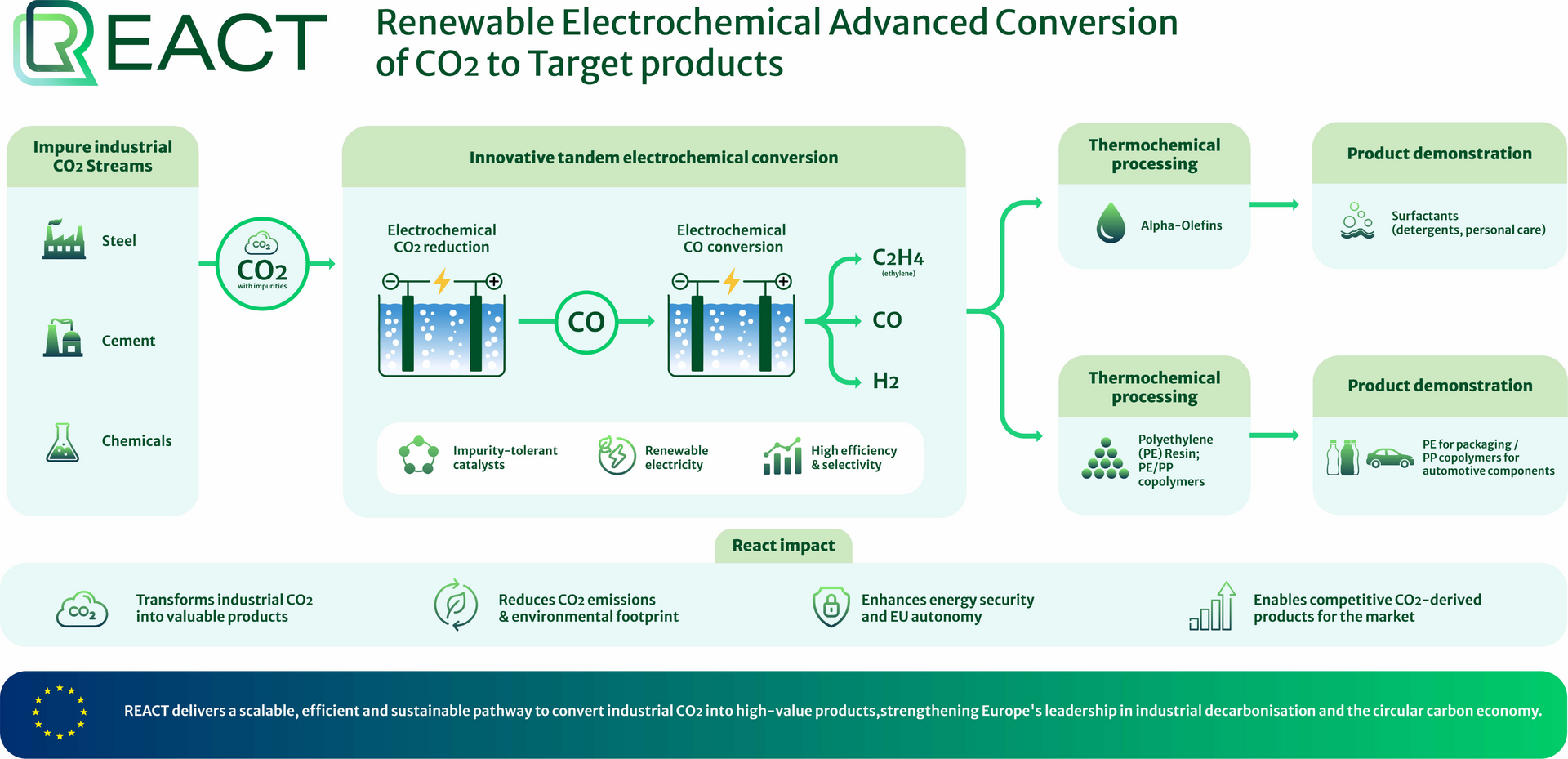
The objective of the project is to develop a sustainable and innovative value-chain for the utilization of industrial CO2emissions. The focus is on converting CO2 into ethylene (C2H4), one of the most important C2 building blocks and a feedstock for a wide range of everyday products, including plastics, detergents, pigment dyes, coatings and other chemical products. Each year, several hundred million tonnes of ethylene are produced worldwide, with conventional production generating greenhouse gas emissions of up to 2 tonnes of CO2 equivalent per tonne of ethylene. The annual ethylene demand of the European chemical industry can only be met through imports. At the same time, European ethylene production relies on fossil feedstocks that also need to be imported, further increasing import dependency. As part of the REACT project, a novel tandem electrochemical process is being developed to demonstrate how CO2 from flue gases of hard-to-abate sectors such as the steel, cement, and chemical industries can be converted into ethylene using renewable energy. Particular emphasis is placed on the development of a robust and impurity-tolerant electrochemical system capable of processing industrial flue gas under real operating conditions. The ethylene produced through this sustainable process will subsequently be converted into products such as packaging (Procter & Gamble), surfactants (Procter & Gamble), and automotive plastics (FARPLAS).
Objectives
The main objectives of REACT are:
Development and demonstration of a sustainable process for converting industrial CO2 into chemicals and polymers
Development of a robust, impurity-tolerant tandem electrolyser
Improvement of catalyst lifetime under real operating conditions
Validation of the use of sustainably produced ethylene in packaging, surfactants, and automotive plastics applications
Conducting techno-economic and environmental assessments
Development of concepts for the industrial scale-up and replication of the technology
Development of digital control solutions to enable the optimal integration of renewable energy sources into the process system
The project is coordinated by SINTEF, Europe’s largest independent research organization. The project consortium consists of a total of fourteen partners from ten different European countries, including seven applied research organizations (EMPA, Holoss R&D, IDENER, K1-MET, NORNER, SINTEF, VITO), four large companies (FARPLAS, Johnson Matthey, Johnson Matthey Davy Technologies, Procter & Gamble Services Company), three small and medium-sized enterprises (eChemicles, Holoss, ETA-Florence Renewable Energies). Within the project, K1-MET plays a central role as a supplier of industrial CO2-containing gases, including their purification, thereby representing the first step in the value chain. One of the key research questions of the project is to determine how pure and concentrated CO2 from industrial emission sources must be to enable an efficient and durable electrochemical conversion to ethylene. K1-MET is actively involved in developing concepts for the industrial scale-up and replication of the technology and coordinates the creation of an impurity-tolerance matrix to support cross-sector implementation under real operating conditions. In addition, K1-MET chairs the Industrial Advisory Board and contributes to the techno-economic assessment.
Further information and updates on the latest activities of the REACT project are available on the official project website: https://www.react-horizon.eu/.
PROJECT TIMELINE:
1 May 2026 – 30 April 2030 (48 months)
FUNDING SCHEME:
This project is funded by the European Union (CINEA - European Climate, Infrastructure and Environment Executive Agency, Grant Agreement no. 101269395).
PROJECT CONSORTIUM:
Starting with the project coordinator, the consortium is composed as follows:
- SINTEF (Norwegen)
- eChemicles (Ungarn)
- EMPA (Schweiz)
- ETA-Florence Renewable Energies (Italien)
- FARPLAS (Türkei)
- Holoss (Portugal)
- IDENER (Spanien)
- Johnson Matthey PLC (GB)
- Johnson Matthey Davy Technologies Ltd (GB)
- K1-MET GmbH (Österreich)
- NORNER Research AS (Norwegen)
- Procter & Gamble Services Company N.V. (Belgien)
- VITO (Belgien)