
 DE
DE EN
EN
Overall approach
Acetic acid, with a global production volume of around 20 million tonnes per year, is one of the most important basic chemicals for the polymer, pharmaceutical, and food industries. Conventional production from fossil-based syngas involves several energy-intensive process steps at high temperatures and pressures. This results in significant CO2 emissions of 1.3–1.8 t CO2 per tonne of acetic acid, as well as the use of critical raw materials as catalysts.
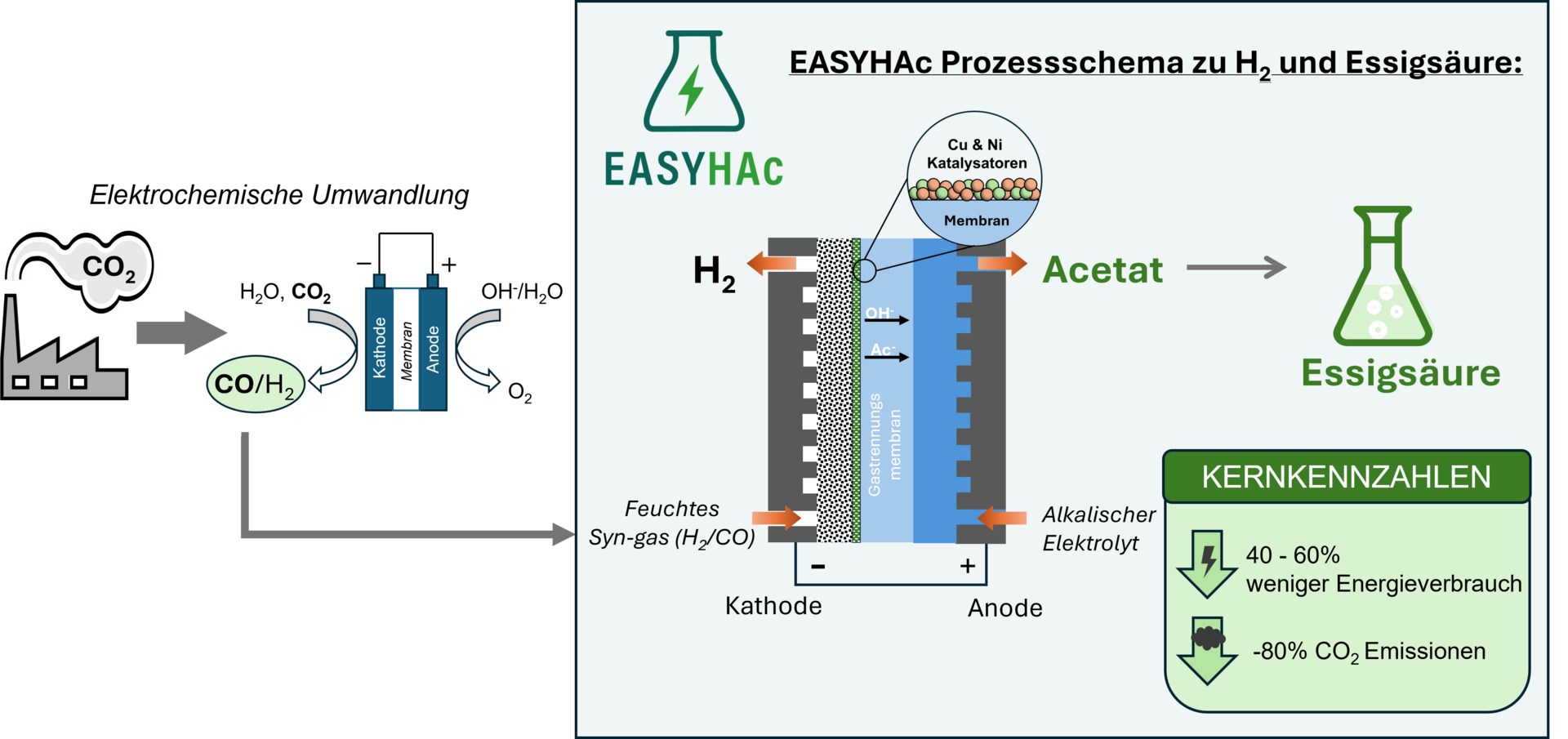
The EASYHAc project aims to develop a novel, electrified, and energy-efficient process for the production of acetic acid, in which CO is converted electrochemically via acetate to acetic acid. Syngas serves as the feedstock and can be obtained either from unavoidable industrial CO2 sources or from biogenic raw materials. The developed technology can therefore be directly integrated into a carbon circular economy, with acetic acid, as a base chemical for numerous industries, simultaneously serving as a potential carbon sink. In addition, H2 originating both from the syngas and as a by-product of water electrolysis is separated at the cathode and can be directly used as an energy carrier or in industrial processes.
The innovation of the project lies in the combination of selective electrochemical reactions at the anode and cathode, requiring low cell voltages, the integration of membranes for targeted mass transport between the electrodes, and the use of scalable Ni- and Cu-based catalysts without critical raw materials. Within the project, a prototype electrolyser (TRL 4) will be continuously operated at industrially relevant current densities to produce highly concentrated acetic acid and green hydrogen with high energy efficiency.
The developed process has the potential to reduce energy demand by 40–60% compared with conventional production and CO2 emissions by approximately 80%. EASYHAc thus makes an important contribution to the decarbonization of the chemical industry and offers potential for new value chains within a low-carbon circular economy.
Objectives
- Development of Cu-based nanocatalysts for the reduction of CO to acetate
- Fabrication of Ni-based electrodes for the selective oxidation to acetate
- Integration of the anodic and cathodic reactions into membrane electrode assemblies (MEAs) and their scale-up
- Recovery and utilization of acetic acid and hydrogen at sufficient concentrations and purity