 DE
DE EN
ENProject CARMA
„CO2-based production of methane and proteins for the decarbonization of industrial processes“ (ATCZ00278)
Overall approach
The programme area encompassing Upper Austria, South Bohemia, and South Moravia faces significant ecological and economic challenges, particularly due to high CO2 emissions from industrial sectors such as steel, cement, and energy production. At the same time, Austria and the Czech Republic are strongly affected by climate change, for example through drought periods and flooding. Since 1900, the temperature in Austria has risen by 3.1 °C – significantly above the global average.
CO2 emissions in 2023 amounted to 114 million tonnes in the Czech Republic and 68.7 million tonnes in Austria. The main contributors are Austrian industry (34%) and the energy sector in the Czech Republic (approximately 30%). This highlights substantial potential for emission reductions.
Another challenge is the dependence of aquaculture on imported fishmeal and soy, as there is a lack of regionally produced and environmentally sustainable feed alternatives.
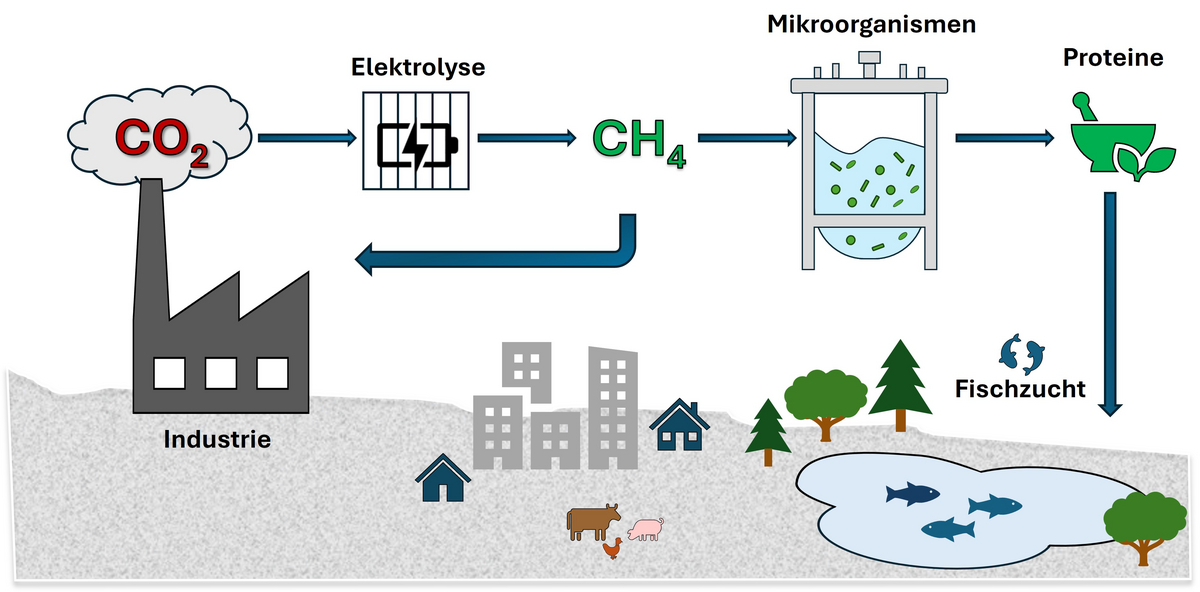
The CARMA project addresses this dual challenge: first, CO2 is to be converted into methane – an important energy carrier for industrial processes – through electrolysis; subsequently, this methane is to be transformed into microbial biomass using methanotrophic microorganisms. Finally, the nutritional composition of this alternative protein source is evaluated, and its digestibility is tested in feeding trials with fish (Fig. 1). This cross-border research approach brings together four research institutions from Upper Austria, South Bohemia, and South Moravia.
Objectives
Within the CARMA project, two key solutions are being developed through cross-border collaboration:
First, a process is being developed to convert CO2 into methane using electrolysis. Methane is an important energy carrier for industrial applications.
Second, the project focuses on transforming industrial CO2 emissions into high-quality microbial protein, thereby contributing to sustainable resource utilization.
Another key focus is on knowledge transfer and networking. This includes several project workshops as well as a two-day final workshop. The aim of these activities is to transfer research results into practical applications, promote exchange among relevant stakeholders, and provide impulses for the further use of the project outcomes.
The results of the three work packages will be published in a total of four open-access publications. In addition, a technical data sheet will be produced, containing essential information on the nutritional value of microbial protein. This data will be made available in a freely accessible database, allowing feed developers, researchers, and other interested parties to access and use them in various contexts.
The research activities are divided into three work packages: Work Package 1 focuses on the conversion of CO2emissions into methane. This involves the development of 3D electrodes and the optimization of electrolysis cells to enable complete CO2 conversion with low energy input. Work Package 2 addresses the conversion of methane into microbial biomass. Suitable bacterial strains are cultivated in specially optimized growth media. In parallel, a bioreactor is developed to ensure optimal flow conditions, stable bacterial growth, and efficient protein production. Work Package 3 evaluates the practical applicability of the produced biomass as an alternative protein source in animal nutrition, particularly in aquaculture. For this purpose, the microbial protein is analyzed in terms of its basic composition, and its digestibility is tested in feeding trials with fish.
Get the latest project information.